Production MLOps Platform · Jul 2026
realtime-anomaly-detection: Streaming Detection and Alerting
Event to deduplicated alert in under two seconds
The problem
Anomalies in streaming data need catching in near real time, and simulated benchmarks lie.
Approach
Redpanda ingestion with Faust stream processing over rolling 1-minute, 5-minute and 1-hour windows. Three detectors with hot-reload: Isolation Forest, LSTM autoencoder and a Z-score baseline, plus severity scoring, alert deduplication and historical replay for backtesting. Validated against a real Kaggle fraud dataset after simulated data returned implausible results.
How it works
- Redpanda ingests events and Faust processes them over rolling 1-minute, 5-minute and 1-hour windows.
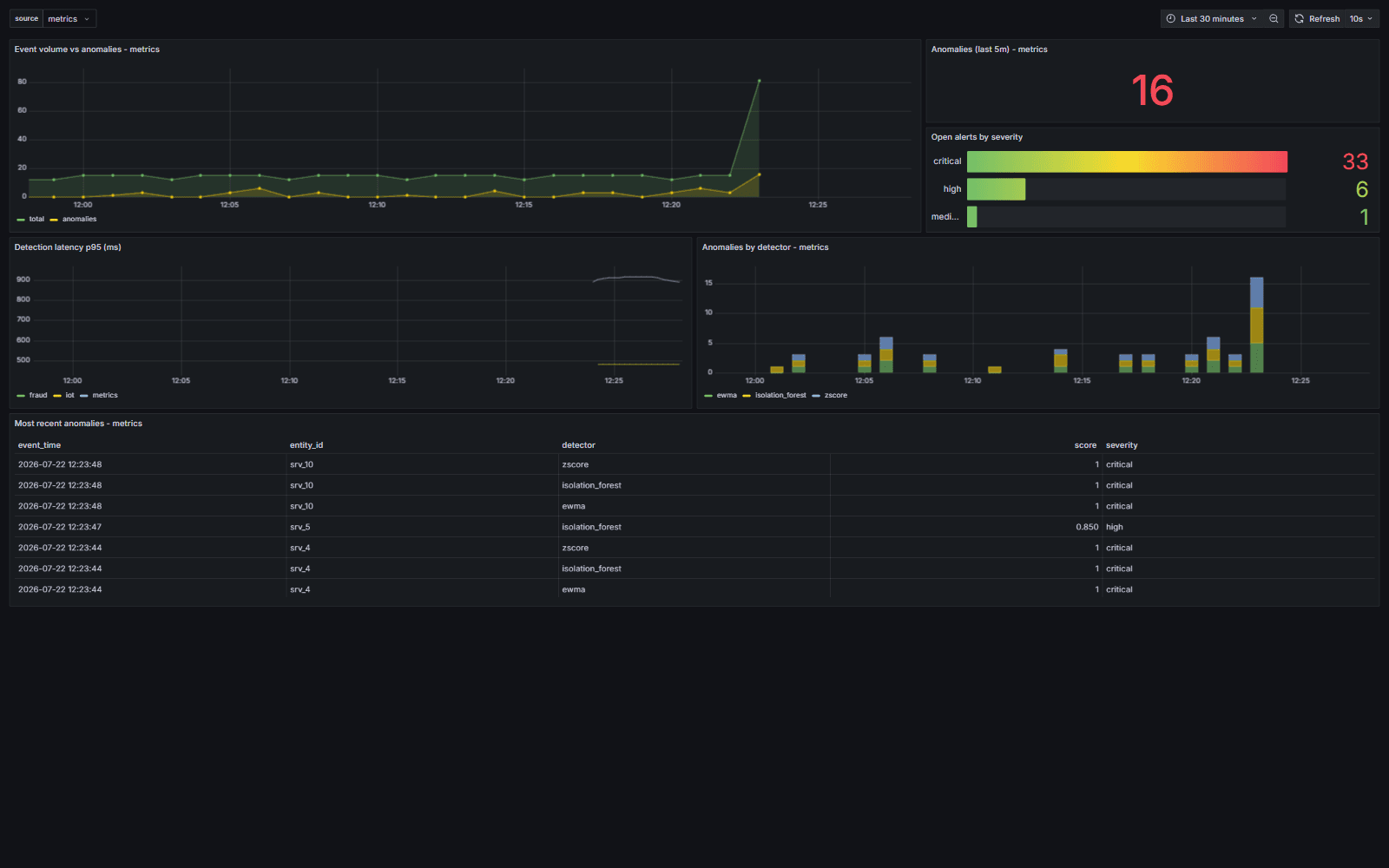
- Detectors are routed per source type: Isolation Forest and Z-score for fraud, Z-score with EWMA for server metrics, an LSTM autoencoder for IoT sequences.
- Z-score tracks a running mean and standard deviation per feature, so it needs no training run and suits high-volume metrics.
- The LSTM autoencoder reconstructs a sequence and flags spikes in reconstruction error, catching temporal anomalies a point detector cannot see.
- Severity scoring and deduplication sit between detection and alerting, so one incident does not become fifty pages.
Key decisions
- Route by source type instead of picking one detector
- Fraud is a multi-feature interaction, server metrics are a deviation from a running baseline, and IoT anomalies are temporal. No single detector handles all three well, so the router chooses per source.
- Distrust the simulator
- Injected anomalies are cleanly separable — large amount and foreign and odd hour, all at once — so the detectors score near-perfectly on them. Those numbers measure the pipeline, not detection ability, and the README says so before quoting any of them.
- Revalidate against real fraud data
- Real base rates are often 0.1% or lower, anomalies look almost normal, and there are usually no labels. The simulated result was published as a warning rather than as a result.
Interface
What broke
- Simulated data returned an implausible ~1.00 precision and recall. The pipeline was revalidated against a real Kaggle fraud dataset, and the simulation result was published as a warning rather than as a result.
Running it
docker compose upFull setup, configuration and API reference are in the repository README.
Stack
- Redpanda
- Faust
- PyTorch
- TimescaleDB
- Grafana
- Alertmanager